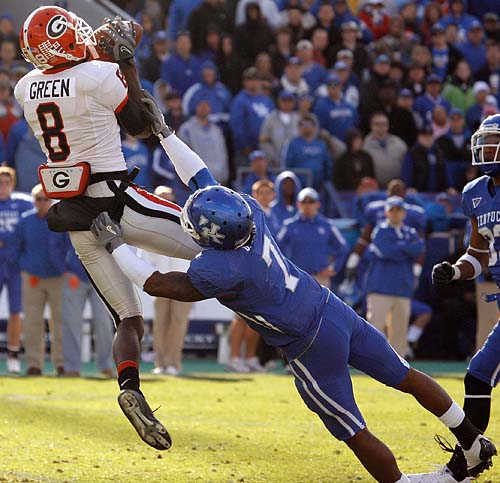
It cannot just be me who thinks that something is being hidden in this entire A.J. Green situation. Admittedly, as much as I have gleaned over the past few months regarding student-athletes, agents, runners, and even coaches all in bed with each other, people kept asking me if I had heard anything about Green, and my answer was no. Yet, everyone was searching for dirt on the Georgia Bulldog.
Then yesterday, word broke that Green will be ineligible for an additional 3 games (on top of the 1 game he already sat out) because he sold a game jersey to an individual who meets the organization’s definition of an agent. Why even say that the person meets the organization’s definition of an agent instead of calling the person an agent, point blank? And with so much out there across the country to investigate, could there really have been such a large focus on A.J. Green because he sold a jersey to an agent?
Either way, this “agent” should be concerned if he is not registered in the State of Georgia. University of Georgia’s official athletic website provides the following:
GEORGIA STATE LAWS
Agents must register with the State Regulatory Commission and are required to post a surety bond of $10,000. No athlete agent may contact an athlete, either directly or indirectly, or otherwise engage in or carry on the occupation of an athlete agent without first registering with the commission.
The state’s athlete agent law, recently revised in 2003, expanded the power of a university to bring civil action against athlete agents in the event their actions cause the institution to be brought before a governing body and penalized. It also provides for civil action against enrolled student-athletes should their actions cause the institution to be brought before a governing body and penalized.
Penalties for violating state laws are felonies incurring fines no less than $5,000 and no more than $100,000 or by imprisonment from 1 to 5 years, or both.

One reply on “Why A.J. Green, And Who Was The Agent?”
Obviously the whole story isn’t being told? Why would the University of Georgia’s athletic personnel want the story out in the open for ESPN to twist and turn like it does so well. However to the other question their isn’t a clear definition of what a sports agent is is their? The guy could have been just an NFL fan who wanted the attention of AJ Green, perhaps a lawyer? Would being a contract lawyer give the committee the grounds to say he could be an agent? I think that the penalty was handed down not because of the nature of the crime but because they needed to show that they are buckeling down on athletes. Selling a jersey may not be that big of a deal but it gives the NCAA some breathing room from coaches who say they aren’t investigating hard enough. We really should find out who this agent was however and what he faces as a consequence.